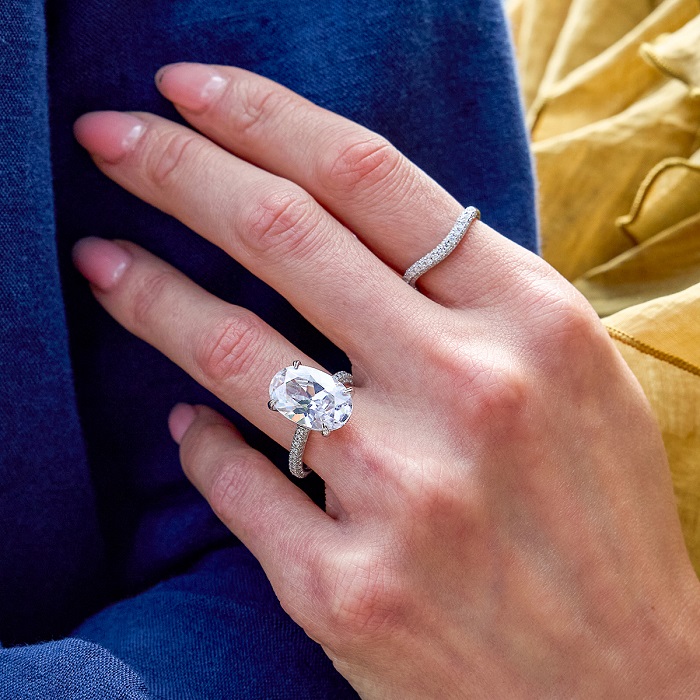
An engagement ring usually gets all the attention. The wedding ring, on the other hand, completes the look. When the pairing works, the two rings feel like they were always meant to sit together.
Choosing wedding rings isn’t about finding something that matches exactly. It’s about understanding proportion, shape, and how the engagement ring already behaves on the hand. Here’s how to pair wedding bands with some of the most popular engagement ring styles without overthinking it.
Solitaire Engagement Rings: Keep It Clean
Solitaire rings are minimal, which makes them incredibly versatile.
For solitaire engagement rings, a semi or a full diamond eternity wedding band is often the easiest pairing choice. Some prefer a slimmer band for a clean, understated look, while others choose a wider band for a more defined band presence on the hand. Both options work equally well with a solitaire, and the choice comes down to how prominent you want the band itself to appear alongside the center diamond.
This pairing works because it respects the simplicity that defines many diamond engagement rings in solitaire settings.
Halo Engagement Rings: Follow the Contour
Halo settings already carry visual weight. The center diamond is framed, elevated, and designed to be noticed.
Straight wedding bands can work with halo engagement rings, but many people prefer contoured or gently curved bands as they create a more cohesive look when the rings are worn together and allow them to sit flush without gaps. It also helps prevent the rings from rubbing or scratching against each other during daily wear.
When the two rings sit comfortably together, they function well as a paired set.
Three-Stone Engagement Rings: Balance Is Key
Usually, people choose three-stone engagement rings for their symbolism, with the center diamond representing the present and the side stones reflecting the past and future. Its design naturally adds visual width, making the ring feel substantial. This pairing relies on restraint. Too much detail on both rings can quickly feel heavy.
Contoured Engagement Rings: Prioritize a Flush Fit
Engagement rings with contoured or shaped bands are designed to curve around the finger. Because of this, a straight wedding band may leave a visible gap when worn alongside it. In these cases, a contoured wedding ring that mirrors the engagement ring’s shape allows the two rings to sit flush.
Emerald-Cut Engagement Rings: Match the Geometry
Emerald-cut engagement rings are defined by straight edges, long rectangular shapes, and step-cut facets. Because the design relies on clean lines, wedding bands that mirror this structure tend to pair best.
Straight wedding bands work particularly well with emerald-cut rings, as they align cleanly with the diamond’s linear shape.
Vintage-Inspired Engagement Rings: Echo, Don’t Copy
Vintage-inspired rings often feature engraving, milgrain, or intricate details. The wedding band doesn’t need to replicate all of that.
Instead, look for a band that references one element. A similar texture, a soft edge, or a subtle pattern is often enough. This keeps the pairing cohesive without turning it into a matched set that feels too deliberate.
Think About How You’ll Actually Wear Them
The most successful pairings aren’t just visually appealing. They continue to feel meaningful and relevant even after years.
Some people wear both rings every day. Others alternate. Some stack additional bands over time. A good pairing allows flexibility without feeling incomplete when worn alone.
That’s why wedding rings should be chosen with everyday wear and longevity in mind.
When evaluating different pairings, seeing how wedding bands sit alongside various engagement rings can make the decision clearer. Brands like With Clarity offer the ability to explore engagement rings and wedding bands together, making it easier to understand overall pairing before committing.
When the Pairing Feels Natural
The best engagement ring and wedding band combinations work well together visually and function comfortably when worn as a set.
When chosen thoughtfully, wedding bands don’t compete with diamond engagement rings. They support them. And together, they become part of a growing collection of diamond jewelry that reflects how someone actually lives and wears their pieces.